Mnemosyn
Patron Saint of the blank page

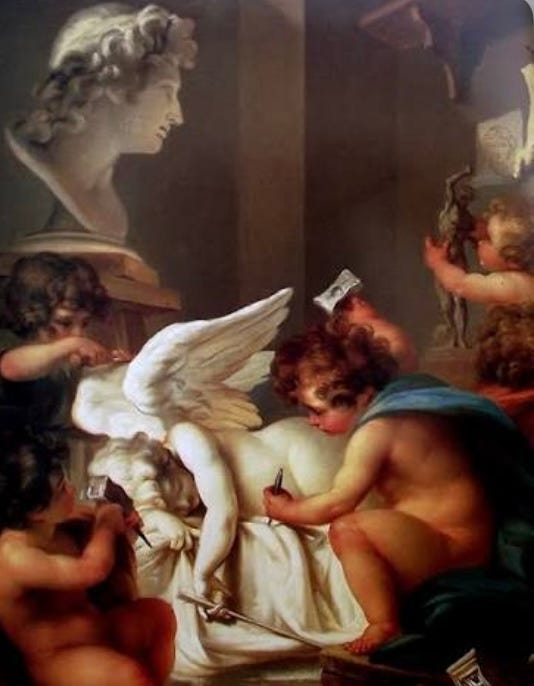
There’s a particular kind of terror that visits writers. It’s not a demon with horns and a contract, it’s the small, humiliating kind.
The kind that whispers: You have nothing, that makes you stare at the cursor like it’s a tiny judge in a courthouse. The kind that convinces you that your mind is an empty pantry, and you are a fraud with a pen.
And then, minutes later, you write a sentence that opens you like your ribcage has been surgically cracked, and suddenly the room fills with birds.
I keep thinking about Mnemosyne, the ancient Greek Titaness, pre-Olympian, older-than-the-gods energy. A force that existed before the world got obsessed with productivity and proof.
In most tellings, she’s the daughter of Uranus (Sky) and Gaia (Earth), which is a mythic way of saying: memory is what happens when vastness touches matter, sky meets bone, and eternity presses its mouth to clay. She isn’t just “remembering facts.” She’s the deep storage of being.
That part of you that knows things you can’t retrieve on demand, the part of you that holds whole lives in the body, even when the mind goes blank, the part that forgets because it’s protecting something tender until you’re ready to hold it without flinching.
Mnemosyne’s biggest mythological role is that she’s the mother of the Nine Muses. Zeus sleeps with her for nine consecutive nights, and she gives birth to the Muses, poetry, music, history, dance, tragedy, comedy, sacred hymn, astronomy, and the whole choir.
And the symbolism is almost rude in its simplicity: Art is what memory becomes when it starts singing. Creativity is memory with a pulse, which means the Muse isn’t some glittery external spirit you have to impress.
The Muse is what happens when Mnemosyne opens a door inside you, and you stop trying to manufacture brilliance, but instead you let remembrance rise from the cellar. The pen becomes a little shovel for unburying, and here’s what’s even more delicious: Mnemosyne isn’t just a gentle librarian goddess with tidy shelves.
In Orphic underworld traditions, she’s paired with Lethe, Forgetfulness. There are stories of the dead arriving in the afterlife and being faced with a choice of waters: drink from Lethe and forget, dissolve, lose yourself; or drink from Mnemosyne and remember who you are, what you’ve lived, what’s true, so you don’t vanish into spiritual amnesia.
That makes her far more than nostalgic. She’s the “don’t lose yourself” current, and there’s an old ritual detail tied to the oracle of Trophonius at Lebadeia: seekers drank from two springs, Lethe to forget ordinary life, and Mnemosyne to remember what they saw in the vision afterwards.. Read that again, slowly this time.
Forget the noise, and then remember the revelation, that’s a real writing practice. That’s a modern survival strategy, because we are living in a world designed to fracture memory. Not just personal memory, but soul-memory, the thread, the sacred continuity of who you are when nobody’s watching.
We doom-scroll ourselves into spiritual dementia.. We forget what we loved. We forget what we were building. We forget the face of our own aliveness, and then we sit down to write and wonder why the page feels like a desert.
Mnemosyne is the opposite of doom-scrolling; she is a curated remembrance. You're not meant to keep the thread of everything that’s ever happened, and the writers with especially tender nervous systems and feral hearts, they are the ones, they are her people, because we are the ones who forget what we know until the pen touches paper.
We don’t retrieve memory like a computer; we summon it and write our way back to ourselves. We bleed our way back to the forgotten rooms, sing our way back to the buried names, and make language into a lantern and then go looking.
So if you’ve been blank lately, if your creativity has felt like it moved out without leaving a forwarding address, this is your permission slip:
You don’t need to force genius; you need to invoke remembrance. You need Mnemosyne in the room as a daily ally, a living practice of retrieval. Your voice is not gone, it’s just downstairs, and I think Mnemosyne has the keys. Here is an Invocation for Mnemosyne, for daily writing and daily remembering.
Mnemosyne—Titan-mother of the Muse-blood, Sky-and-Earth daughter, keeper of the thread, come close to me now.
Stand behind my shoulder as I face this page, and put your hand on the back of my neck. Slow down the panic and unclench the performance. Teach me the difference between hiding and forgetting.
Teach me what my body knows, but my mind can’t fetch. Teach me the sacred kind of recall. Let me not drink from Lethe. I must only ever forget all the noise and remember the revelation.
When I’m empty, show me the underground river. When I’m scattered, gather me by my breath. When I’m ashamed, return me to truth without cruelty.
Open the archives that live between my ears, bring back the names I swallowed with no water. Bring back the parts of me I exiled to survive, and if the Muses come, let them come as a pulse, not as a performance. Let them come as a flame, not as a brand. Let the field of living language move through my hands.
Mnemosyne, make my writing memorable. Make my remembering a becoming. Make me become a home. So be it.
Amen.
Whatever words get the door open, I hope this stirred something in you. If you felt a little click of recognition in your chest, consider this a gentle nudge to practice it. One paragraph a day. One honest sentence. One cup of remembrance poured slowly.
Subscribe if you’re tired of performing your life instead of living it. Subscribe if you want writing that doesn’t just talk about the sacred, but tries to touch it daily, clumsily, bravely, with hands still shaking.
And if you want to help keep this work going because ink costs, life costs, and the Muse enjoys being fed, you can shout me a coffee here:
P.S. Please subscribe, because my infinite ink is out here doing parkour off the void, and it would love a witness.
I really enjoyed this. It floats in abstraction in a way that feels intentional and nourishing — like staying in the high register of myth and memory without rushing back down. Sometimes that’s exactly what’s needed.
I’ve noticed, though, that after pieces like this, I personally feel the urge for a counterweight — something concrete, interruptive, or even a little ugly — just to help the insight land in the body. The two modes feel complementary rather than opposed.
Thank you for this reminder to linger.
Don’t worry, your writing is memorable and it matters.